Mature processes and coordinated equipment
Clear, mature process routes, coordinated equipment and simple layouts, with a small footprint and low investment requirements.
Corn Starch Sugars
Maltose syrup is used for food browning/coloring, moisture retention and taste. Typical concentration is about 75%, with syrup types differentiated by mono-, di- and trisaccharide composition.
Starch sugars include glucose, maltose and fructose syrups. Glucose syrup is generally used for fermentation; maltose syrup for food browning/coloring, moisture retention and taste; fructose syrup as a beverage sweetener.
Complete route with additions, filter residues, condensate and off-spec returns.
Clear, mature process routes, coordinated equipment and simple layouts, with a small footprint and low investment requirements.
Low steam, electricity, acid/alkali and water consumption per unit of product. Uses mature maltose and fructose production technology.
Typical KORN process figures and technical advantages. Final parameters are subject to project design and the technical agreement.
Original bilingual process diagram from the company brochure. All labels and connections are preserved. Translated text outside the diagram is a reading aid.
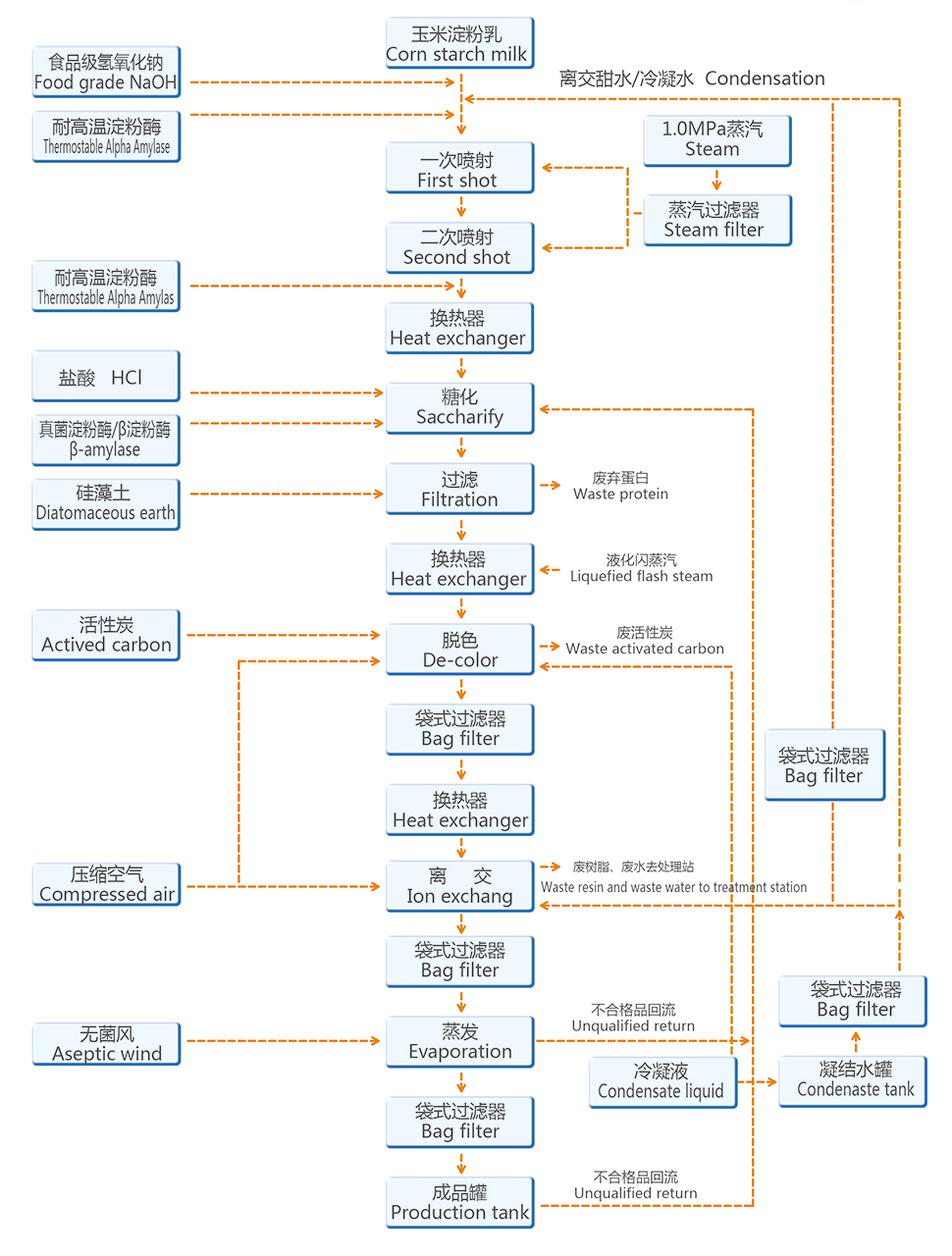
Starch milk: food-grade NaOH and thermostable amylase; reuse of ion-exchange sweet water/condensate.
First jet: 1.0 MPa steam supplied through a steam filter.
Add heat-resistant amylase at the heat exchanger.
Saccharification: HCl and fungal amylase/β-amylase.
Filtration: add diatomite and separate protein residue.
The heat exchanger recovers liquefaction flash steam.
Decolorization: activated carbon added and spent carbon separated.
Ion exchange: compressed air; spent resin and wastewater to treatment.
Evaporation: sterile air supply; the diagram marks off-specification return points.
Tell us about your raw material, target product, planned capacity and project location.
Project inquiry